I invent world changing things from time to time… Smart Phone, LLM, Von Nuemann Probes, all me: www.techaform.com
This is an outside rim of a SRM motor that can be actively monitored and even driven forward by the monitor via Ardino, then regulated by the software.
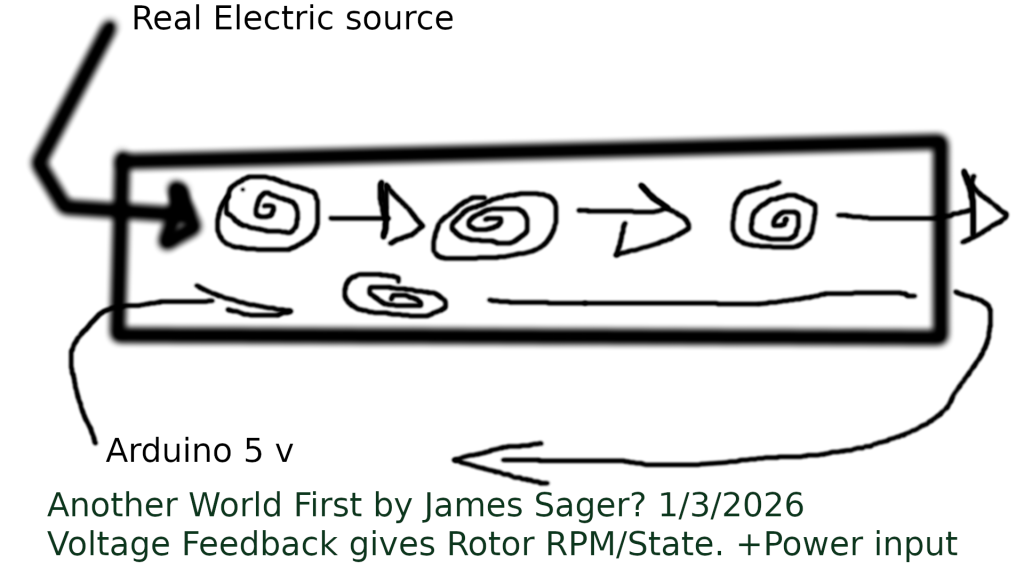
Dual-Channel Arduino-Based SRM Control System
Overview:
A dual-channel control architecture for Switched Reluctance Motors (SRMs) that leverages a low-cost Arduino to achieve sensorless real-time rotor feedback, minimizing hardware complexity while maximizing efficiency and torque.
1. High-Power Drive Channel
- Energizes the SRM’s main stator coils to produce torque.
- Uses standard MOSFET or IGBT switches.
- Handles full motor voltage and current.
2. Low-Power Sensing Channel
- Uses auxiliary coil(s) or lightly tapped main coils.
- Induces a small voltage proportional to rotor position and speed.
- Conditioned for microcontroller input via:
- Voltage dividers
- Op-amp buffers
- RC filtering
Draws negligible current; does not affect torque.
3. Arduino / Microcontroller Control
- Reads voltage from the sensing channel via ADC inputs.
- Calculates:
- Rotor angle
- Rotational speed (RPM)
- Optional torque/load estimates
- Adjusts high-power PWM timing in real time for optimal torque and efficiency.
4. Key Advantages
- Parts Reduction: Eliminates Hall sensors, encoders, and extra isolation circuits.
- Cost Efficiency: Arduino-level controller replaces costly DSP/FPGAs.
- Scalability: Works from hobby motors to high-torque EV-sized SRMs.
- High Reliability: Sensorless design with minimal hardware → fewer points of failure.
- Energy Efficiency: Real-time feedback aligns coil energization with rotor state, reducing torque ripple and copper losses.
5. Why This Matters
- Electric Vehicles: Fewer parts, lower weight, easier maintenance.
- Aerospace / Space Systems: Robust, low-complexity, reliable.
- Rapid Prototyping: Arduino-friendly implementation allows fast iteration while maintaining precision.